Motor runs, door won't move
Often caused by a worn drive gear, broken coupler, failed capacitor (on some models), or a trolley/engagement issue. We verify the door moves by hand before putting strain back on the opener.
Serving Macclenny, Florida
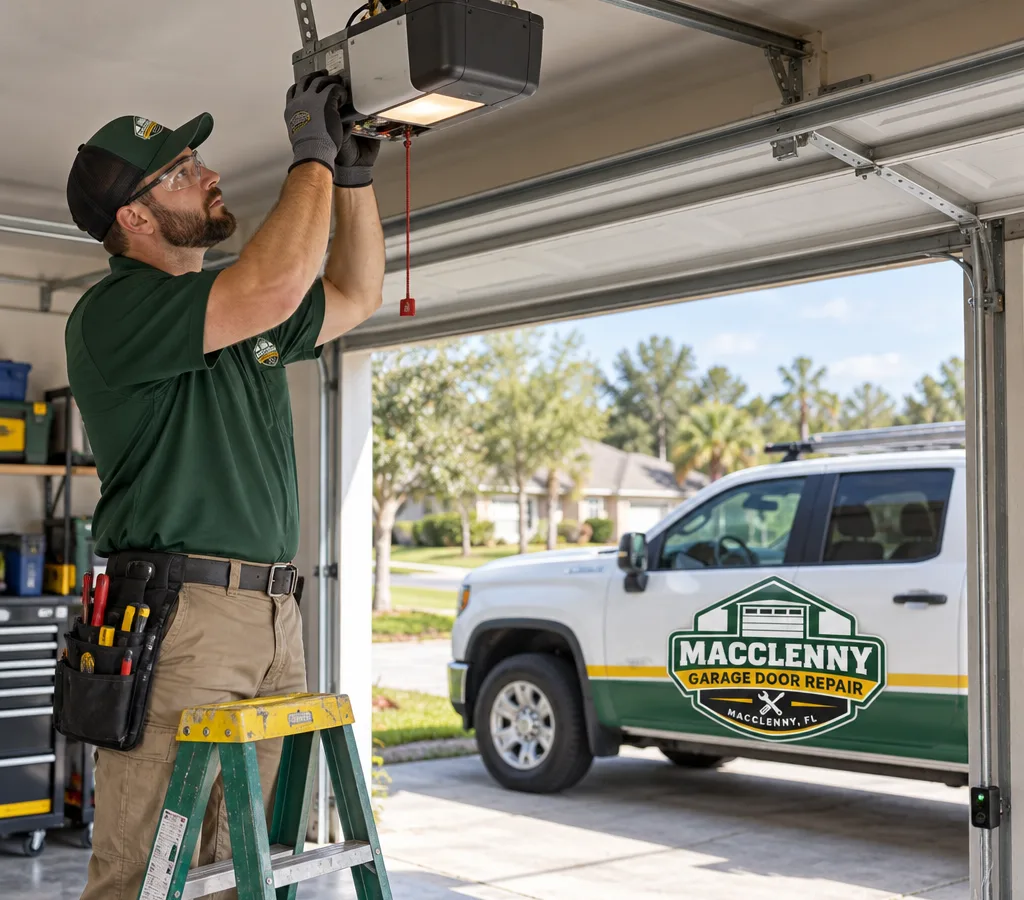
Opener Repair · Macclenny, Florida
When your door won't open, reverses for no reason, or the remote stops working, we diagnose the opener system and fix what's actually failing so it runs safely again.
If you're searching for opener repair Macclenny FL, you're probably dealing with a door that won't lift, an opener that hums but doesn't move, or a door that starts down and then pops back up. Those symptoms usually come from a handful of parts: the drive system (chain, belt, screw, or direct drive), the logic board, the safety sensors, the wall control, the remote receiver, or the power and wiring feeding the unit.
Macclenny Garage Door Repair handles garage door opener troubleshooting and repair in Macclenny, Florida for the equipment that actually moves the door, not just the door itself. When a garage door company Macclenny homeowners rely on does the work, we focus on clear diagnosis first, then a repair plan that matches how the opener is used day to day. You'll get straightforward options, and we'll explain what we found before any parts are replaced.
Because openers are part electrical and part mechanical, a good repair starts with safety checks: verifying the door is balanced (so the opener isn't fighting the door), confirming the photo eyes are aligned and wired correctly, and checking travel limits and force settings. Fixing the wrong thing can burn up a motor, strip gears, or create a safety hazard, so we work methodically.
Often caused by a worn drive gear, broken coupler, failed capacitor (on some models), or a trolley/engagement issue. We verify the door moves by hand before putting strain back on the opener.
We check batteries and programming, then move to receiver issues, antenna placement, wall button function, and logic board problems. If a keypad is unreliable, we test it under real use at the door.
Photo eye sensors that are misaligned, dirty, sun-glared, or intermittently wired can stop closing. We also check travel limits and force settings, because an opener that “thinks” it hit the floor will reverse.
Noise can come from a dry rail, worn chain/belt tension, loose mounting, or an opener that's compensating for a heavy door. We isolate the sound source so you're not replacing the wrong component.
We inspect outlets, GFCI circuits, loose connections at the opener, and the logic board. Surges and age can cause boards to act up long before they fail completely.
A stuck button, failing wall station, or wiring fault can mimic bigger problems. We test controls and wiring continuity to pinpoint the true failure.
A reliable opener repair is more than swapping a remote or tightening a chain. We treat the opener, door, and safety system as one unit, because they all affect how the opener performs.
Typical checks during opener repair in Macclenny FL include:
Macclenny has a mix of detached garages, attached garages, and older doors that may have been converted to a newer opener over time. When an opener seems “weak,” the root cause is sometimes a door that has gotten harder to move, not the motor itself. We'll point that out so you can choose a repair that actually lasts.
Opener Repair Process
We test the door by hand, inspect sensors and controls, and confirm power and settings. We won't guess at parts when a heavier-than-normal door load is the real issue.
You'll get a practical plan: what failed, what it takes to repair it, and when replacement is the smarter choice due to age, parts availability, or repeated failures.
After the repair, we run multiple open/close cycles, verify safe reversing behavior, and confirm remotes/keypad operation before wrapping up.
Service Details
Humming motors, stripped gears, trolley engagement problems, worn chains or belts, and rail issues can all stop power from reaching the door.
Photo eyes, wall controls, remotes, keypads, receivers, and wiring are tested together to isolate intermittent or complete control failure.
Logic boards, close limits, travel limits, and force settings are checked when the opener reverses, stops short, or behaves unpredictably.
If your opener is acting up, diagnose it before continued use risks a bigger failure.
Common Questions
It usually means the motor is getting power but the drive system is not transferring that power to lift the door. Common causes include a stripped internal gear, a disengaged trolley, a broken coupler, or a door that has become too heavy for the opener due to spring or hardware issues. We confirm the door moves smoothly by hand first, then test the opener's drive components so the repair targets the real failure.
A closing-and-reversing door is most often a safety sensor issue or a travel/force setting issue. If the photo eyes are misaligned, dirty, sun-glared, or intermittently wired, the opener treats it like an obstruction and reverses. We check sensor alignment and wiring stability, then verify the close limit so the opener isn't “thinking” it hit the floor early.
Yes, because the problem is usually in the opener's receiver circuit, programming, antenna placement, or the remote itself. When the wall control works, it tells us the opener has power and can run, so we focus on the radio/receiver side and the remote or keypad programming. We also check for interference sources and confirm consistent range at the driveway.
Many sensor problems are repairable because the issue is alignment, bracket movement, lens dirt, or wiring at the terminals, not a dead sensor. If a sensor is cracked, water-damaged, or fails testing, replacement is the right fix. Either way, we verify proper reversal behavior after the work is done.
Repair makes sense when the unit is otherwise consistent and the failure is limited to a specific part like a gear kit, capacitor, wall console, or sensors. Replacement can be the better value when parts are no longer available, the logic board has repeated issues, or the opener struggles because it's mismatched to the door's size and weight. After diagnosis, we'll explain the tradeoffs so you can choose based on reliability, not guesswork.
Start with safe checks: replace remote batteries, make sure the opener is plugged in, check for a tripped breaker or GFCI, and wipe the photo eye lenses. If the door won't close, confirm nothing is blocking the sensor beam near the floor. Avoid repeatedly forcing the opener if it's straining or reversing, because that can strip gears or overheat the motor. If you're also dealing with a door that feels heavy by hand, garage door spring repair often needs to be addressed first so the opener isn't doing the springs' job.
Yes, opener repairs commonly involve chain, belt, and screw drive systems, plus the same core components like sensors, logic boards, wall controls, and travel limits. The exact parts and steps vary by brand and model, so we diagnose based on symptoms and what we find on-site rather than assuming one standard fix.
Opener Service
Call Macclenny Garage Door Repair for garage door opener diagnosis and repair.